
Procurement Supply Chain Policy
Beetroot Consulting Ltd
Version: 1.2
Effective Date: April 2025
Review Date: April 2027
Owner: Director
Applies To: All staff, contractors, and individuals procuring or commissioning on behalf of Beetroot Consulting Ltd
1. Policy Statement
At Beetroot Consulting Ltd, procurement and supply chain relationships are grounded in our values of care, equity, anti-oppression, and matriarchal leadership. We do not separate our purchasing choices from our social and ethical commitments. Every supplier, sponsor, and funding partner reflects on our work, so we approach procurement as a strategic and relational responsibility.
We are a small, remote-first organisation with a networked model of delivery. Many of our suppliers and collaborators are known experts and trusted specialists. Our procurement processes are intentionally proportionate, pragmatic, and values-driven.
2. Purpose
This policy provides a framework to:
Procure goods, services, and expertise responsibly
Ensure alignment with Beetroot’s Equity, Diversity, Inclusion & Belonging Policy (POL-EDIB-002)
Conduct supplier due diligence and risk management
Manage sponsor, supplier, client, and partner relationships ethically
Safeguard data, resources, and business continuity
Maintain fairness and integrity in decision-making
3. Scope
This policy applies to:
Suppliers, contractors, and service providers
Technology and platform licensing
Sponsorships and income-generating partnerships
Clients and delivery partners
Any transaction or collaboration that results in the exchange of money, services, data, or reputation
It covers both formal procurement and informal or relational commissioning — particularly where financial risk, client exposure, or reputational considerations are present.
4. Procurement Principles
We procure responsibly by applying the following principles:
Values-aligned — suppliers and partners must not cause harm or conflict with our EDIB, access, or safeguarding standards
Proportionate — the size of the contract dictates the depth of process
Transparent — decisions must be justifiable and free from unexamined bias
Secure — all providers must meet minimum standards of data and information security
Collaborative — relationships are based on care, clarity, and mutual benefit
Sustainable — environmental and social impact is always considered
5. Supplier & Partner Expectations
Suppliers and partners are expected to:
Demonstrate ethical business conduct and inclusive practices
Align with our anti-oppression, equity, and access values
Deliver within agreed timelines and scopes
Respect data protection and client confidentiality requirements
Maintain appropriate insurance and certifications
Be open to light-touch performance reviews or relationship check-ins
6. Sponsorship, Donations & Client Alignment
We may decline or terminate relationships with sponsors or clients whose operations:
Perpetuate or profit from structural oppression
Compromise Beetroot’s independence, mission, or integrity
Present ethical, reputational, or harm-related concerns
Funding and partnerships must pass a values-alignment review, which may include EDIB impact prompts or Director-level discussion.
7. Security & Due Diligence
7.1 Minimum Due Diligence (All Suppliers)
Identity and registration checks
VAT or tax confirmation (where applicable)
Clear scope, contract, and contact lead
Basic financial stability review (as feasible)
Record of agreed terms, deliverables, and review dates
7.2 Enhanced Due Diligence (where applicable)
Required for suppliers who:
Access client or sensitive data
Deliver under Beetroot’s brand or contracts
Integrate with our systems or platforms
Are high-value or long-term partners
May include:
Data Processing Agreement or DPIA
Cyber Essentials, ISO, or other security credentials
References or past performance evidence
Evidence of EDIB, safeguarding, or ethical commitment
8. Ethical Procurement & Supplier Preferences
We actively prioritise suppliers and partners who:
Are led by or centre marginalised communities
Operate sustainably and ethically
Have accessible, inclusive, or trauma-informed delivery models
Contribute positively to social change
Offer transparent governance and fair employment practices
This preference supports impact — but does not exclude others.
9. Approval & Delegation
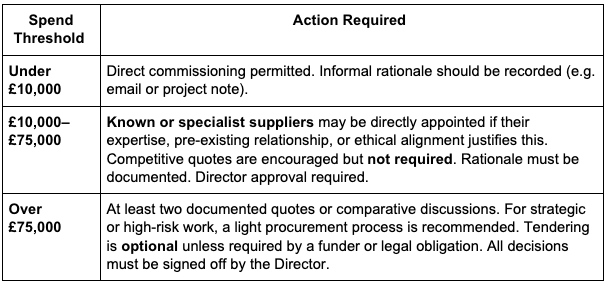
Suppliers may be re-engaged without repeat processes if the prior work was recent, high quality, and risk profile remains low.
10. Contracts, Agreements & Documentation
All supplier, sponsor, and partner arrangements must include:
A contract or agreement outlining services and terms
Confirmation of confidentiality, EDIB, and safeguarding expectations
Payment timelines, review points, and termination clauses
Ownership of work outputs and IP (if relevant)
Where relevant, we will include our Client Inclusion Commitment Statement or customised EDIB clauses.
11. Risk & Exclusion
We may exclude suppliers or partners where:
There is unresolved harm, breach, or misconduct
Due diligence flags a serious risk to data, delivery, or safety
Their values, affiliations, or operations significantly conflict with our mission
Where concerns emerge during delivery, the Director will initiate a relational and values-based review.
12. Related Policies & Tools
POL-FIN-006 – Staff Expenses Policy
POL-HR-005 – Professional Boundaries Policy
POL-EDIB-002 – Equity, Diversity, Inclusion & Belonging Policy
POL-DP-007 – Data Protection & Privacy Notice
TEM-EDIB-008 – EDIB Impact Reflection Prompt Sheet
TEM-FIN-011 – Procurement Decision Log (optional use)
TEM-DP-016 – DPIA Template (where applicable)
13. Review and Accountability
This policy will be reviewed every two years, or sooner if:
External guidance or legal frameworks shift
Our scale, funding, or client base changes
A delivery issue, complaint, or internal reflection prompts revision
Next Review Due: April 2027